
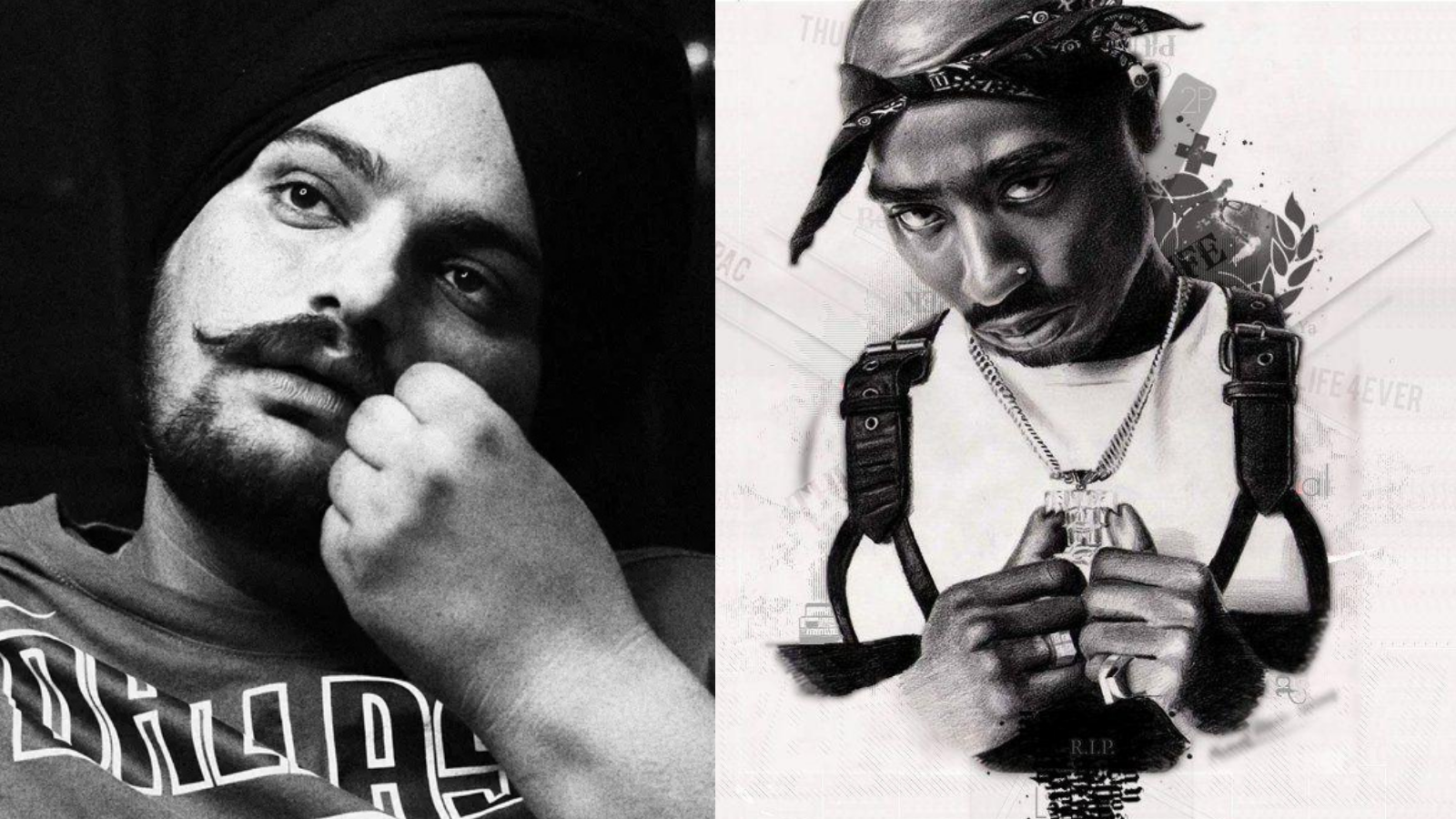
If you know, you know. The moment you hear the opening chords of “Dear Mama” or the raw passion of “Same Beef,” you’re not just listening to a song. You hear a life story, a war cry, and a heart pouring out over a track.
Separated by an ocean and two decades, Tupac Shakur and Sidhu Moosewala shouldn’t have much in common. One was the face of West Coast hip-hop in the 90s; the other was the king of Punjabi rap in the 2020s. But his millions of fans find his stories all too familiar. It’s the same fire, just burning in a different time.
It’s the same story, told in a different time.
Let’s break down why the legacies of these two icons feel so deeply connected.
1. The Persona: Thug Life vs. Jattizm
Both Tupac and Sidhu built their music around a powerful, and often misunderstood identity.
Tupac coined “Thug Life.” For him, it wasn’t about glorifying crime. It was an acronym: The Hate U Gave Little Infants Fucks Everybody. It was a philosophy born from systemic oppression, poverty, and a lack of options. It was the armor of a young Black man in America, refusing to be broken by the system.
Sidhu championed “Jattizm.” In his context, this wasn’t just about caste pride. It was about the spirit of the farmer the resilience, the grit, the unyielding pride of a community that feels both foundational and marginalized. It was an identity rooted in the soil of Punjab, reflecting the struggles, aspirations, and raw masculinity of his people.
Both personas were shields. They were ways of saying, “You see me as a thug? You see me as just a Jatt? Fine. But I will define what that means, and I will pour my pain and pride into it.”
2. The Poetry: Vulnerability in Disguise
This is the big one. The secret sauce. Behind the tough exteriors, both were profound poets.
Listen past the heavy beats of Tupac’s “Hail Mary.” Now, listen to the lyrics of “So Many Tears,” where he bares his soul: “I suffered through the years and shed so many tears…” He wrote love letters to his mother, questioned God, and spoke about the vulnerability of Black men.
Now, switch to Sidhu. Beneath the booming 808s of “Legend,” you’ll find a man singing about his parents in “Just Listen.” Or the sheer existential angst in “295,” where he directly references the system pitted against him: “Saanu phasiyan de ke, kehnde ne asi kattakhami karde… (They hang us, and then accuse us of being rebellious).”
They both used their music as a diary. They weren’t afraid to show fear, pain, and love. This vulnerability is what made their “tough” songs feel authentic and their introspective songs feel like a punch to the gut.
3. The Reality: Art Imitating Life (and Vice Versa)
Their track wasn’t just amusement; it turned into a blurred line with truth.
Tupac’s lifestyles became a series of public battles prison fights, physical altercations, and a infamous taking pictures. His lyrics had been packed with paranoia and a sense of drawing close doom, which tragically reflected his fact. He lived the lifestyles he rapped approximately.
Sidhu Moosewala’s music was steeped in the themes of glory, legacy, and conflict. He often referenced rivalries and a life under constant scrutiny. Tragically, his art also became his reality when he was gunned down in a manner that felt like it was ripped from one of his own narratives.
This blurring of lines created a powerful, and ultimately tragic, authenticity. Fans didn’t just listen; they felt they were witnessing a real-life epic unfold.
4. The Prophecy: A Voice from the Grave
This is the most chilling parallel. Both artists seemed to predict their own untimely deaths.
Tupac’s discography is filled with what now sound like prophecies. In “Life Goes On,” he imagines his own funeral. In “Only God Can Judge Me,” he raps, “I’m hopeless, they should have shot me as a baby.” He had a pervasive sense that he wouldn’t live long.
Sidhu, especially after the death of another young artist, frequently sang about his legacy and mortality. In “Last Ride,” the lyrics are painfully prescient. Songs like “Jatt Da Muqabla” and “Legend” are now viewed as self-written epitaphs. It’s as if they both knew their flame burned too brightly to last.
The Same Story, A Different Time
So, what does this all mean?
Tupac was the voice for a generation of young Black Americans navigating post-Civil Rights era struggles, crack epidemics, and mass incarceration.
Sidhu was the voice for a generation of young Punjabis, both in India and the diaspora, grappling with identity, agricultural crisis, and a new kind of globalized masculinity.
Their contexts were worlds apart, but the human emotions they tapped into were universal: the search for respect, the weight of identity, the expression of pain, and the desire to be remembered.
They weren’t just musicians; they were chroniclers of their people’s spirit. The best rappers gave a voice to the voiceless, turning personal struggles into powerful stories. In doing so, they became more than artists—they became symbols of resistance, truth, and identity.
And that’s a story that, sadly, continues to repeat itself, no matter the time or place.
What do you think? Are there other artists today who carry this same torch? Share your thoughts in the comments.
Leave a Reply